The Swarm Police: Open-Sourcing the Fortress Detection Engine
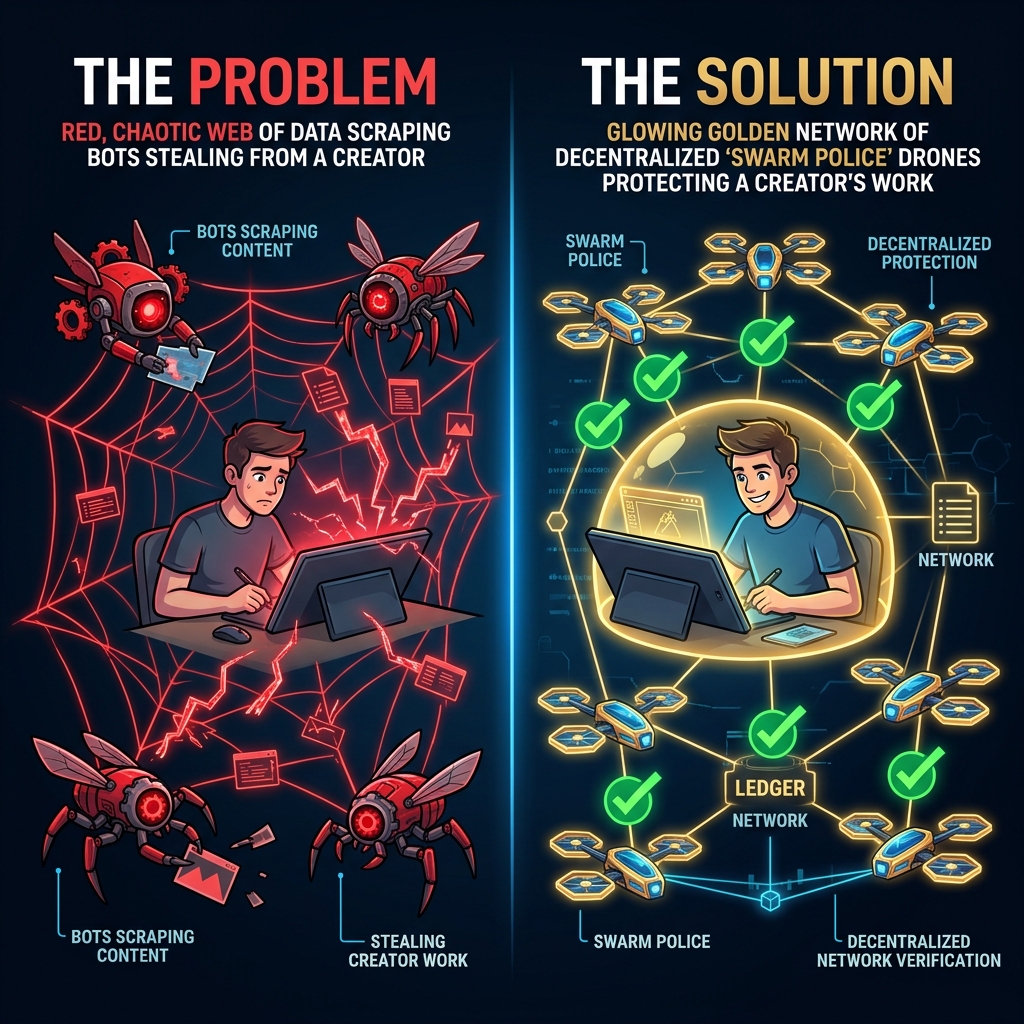
⚡ Executive Summary
We hold the proprietary patents for deep forensic video and audio embedding. But indexing the entire internet for stolen content is an impossible task for any single entity. By making the Fortress Detection Engine open source, we empower thousands of developers to build autonomous "Scraping Demons" that scan closed networks (Darknet, Telegram, WhatsApp) for watermarked content. The result? A decentralized Swarm Police that protects creators, enforces fair pay, and turns the Fortress standard into an omnipresent, unevadable layer of copyright protection.
Start with WHY: The "Impossible Index"
Once upon a time, creators published their work online, only to have it scraped, remixed, and stolen by faceless corporations and bad actors. Every day, they lost revenue and control, completely helpless against the sheer, unmanageable scale of the internet.
If you create a piece of art, a 3D blueprint, or a proprietary dataset, you face an insurmountable problem: The internet is too dark and fragmented to police centrally. Even the largest search engines cannot peer into private Telegram rings, encrypted WhatsApp groups, or decentralized Darknet markets.
We realized an uncomfortable truth: We cannot index the entire internet ourselves. To protect the creative economy, we needed an army. We needed the community.
The Architecture of the Swarm Police
One day, we made a strategic decision: We open-sourced the Fortress Detection Demons. A "Demon" in this context is an autonomous, lightweight software agent. Instead of acting as a malicious scraper stealing data, it acts as a sentinel—a "Good Cop."
🔴 The Pain: Unevadable Theft
Creators are constantly exploited by generative AI models and anonymous distributors. Traditional DRM fails when files are transcoded or recorded off-screen.
🟢 The Solution: Decentralized Sentinels
Fortress uses DWT to embed surviving watermarks. The Swarm Police uses open-source crawlers to detect these watermarks anywhere on the internet.
🟣 What They Use Now
Current solutions rely on central databases and reverse image searches, which are entirely blind to closed messaging groups and the Darknet.
🟡 Target Buyers
Developers seeking bounties, LegalTech firms enforcing IP, and enterprise content platforms (like streaming services and publishers).
How the Community Wins (Fair Pay & Fair Play)
Because of our open-source release, thousands of developers worldwide can now build and deploy these Demons to specialized platforms. You can write a `Telegram-Fortress-Bot` that sits in a group, scanning every uploaded video for a Fortress API payload.
The Incentive: When a community developer's Demon successfully identifies unauthorized usage of a watermarked asset that leads to a recovery or royalty enforcement, the developer earns a direct XOM bounty. This creates a massive, organic rollout of detection grids. Developers are no longer just scraping data; they are the highly-paid protectors of the new internet.
The Duarte Shift: From Vulnerability to Ubiquity
What is: The internet is currently too vast to police centrally.
What could be: A decentralized swarm of millions of autonomous sentinels ensuring compliance.
What is: Developers build scrapers to bypass paywalls.
What could be: Developers build scrapers to enforce fair compensation and earn a share of the revenue.
What is: Creators live in constant fear of their work being exploited.
What could be: Creators publish freely, protected by cryptographic, mathematical boundaries.
Until finally, the Fortress standard becomes ubiquitous. It becomes the de-facto standard not because we forced it, but because it is the most heavily policed standard in the world. And ever since that day, creators could share their work openly without fear, establishing a new era of Forever Peace.
Tactical Wedge: The LegalTech Deployment
For Law Firms and Intellectual Property enforcers, the open-source detection engine means you can instantly spin up localized "Demon Swarms" targeted at specific infringing networks. By utilizing the open-source community's custom-built platform adapters, you achieve 100% visibility into previously dark channels without spending millions on internal R&D.