The FAIR Protocol SDK Strategy and What It Means for the Planet
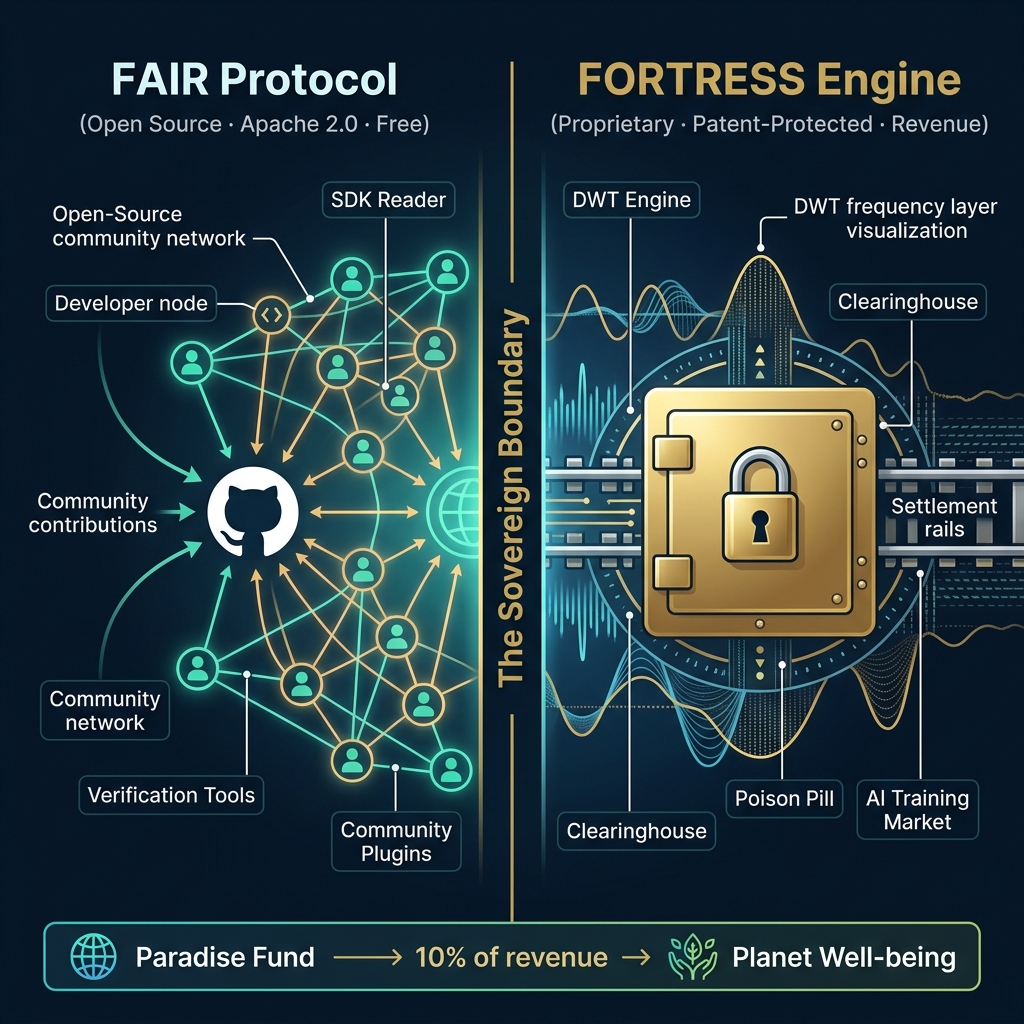
The FAIR Protocol reader is open-source (Apache 2.0). The DWT engine that writes watermarks is proprietary. Open-source developers can build readers, verification tools, community plugins, and language ports — and the strongest contributions get POAW-attested and merged into the official SDK. When revenue flows, 10% goes into the Paradise Fund and 5% into the Social Infinite Source Fund — both channeled directly back into the open-source and planetary well-being ecosystem. This isn't charity. It's architecture.
Start With Why: The Debt the Internet Owes
Somewhere right now, there is a developer spending their Saturday fixing a security bug in an open-source library that makes three AI companies $400 million a year. They will receive no payment, no attribution, and no share of that value. This has been the default operating model of the internet since 1991.
Open source built the stack. Closed source captured the value.
The FAIR Protocol was designed with this asymmetry in mind. Not because it's nice to give back. But because a standard that doesn't serve the community that sustains it will eventually be forked by someone who will. We chose to solve this structurally — before anyone had to ask.
The Sovereign Boundary: What Is Open, What Is Closed
The distinction sounds simple. The reasoning behind it took months to reach.
The FAIR Protocol is a trust standard. Like TLS or OAuth, trust standards only work when they are universally verifiable. An AI lab auditing whether a dataset is clean must be able to verify the signature without asking us for permission. A journalist checking whether a leaked document was tampered with cannot depend on a proprietary black box. The reader is free because verification must be trustless.
The FORTRESS Engine — the DWT embedding engine, the poison pill generator, the clearinghouse settlement rails — is proprietary because monetization and protection must be sovereign. If anyone could write FORTRESS watermarks, the adversarial payload would collapse. The security model depends on the secrecy of the embedding process, combined with the openness of the verification process. This is not unlike how public-key cryptography works: the verification key is public; the signing key is private.
| Layer | Status | License | Why |
|---|---|---|---|
| FAIR Protocol Reader (Node.js, Python, Go) | Open Source | Apache 2.0 + Patent Retaliation Clause | Verification must be trustless and universal |
| did:fortress DID Method Spec | Open Source | Apache 2.0 | W3C standard → community-owned |
| Adversarial Test Suite | Open Source | MIT | Community audit strengthens the standard |
| FORTRESS DWT Embedding Engine | Proprietary | Patent-protected (3,000+ claims) | Security model depends on embedding secrecy |
| Settlement Clearinghouse | Proprietary | Trade secret + patent | Revenue rail — the Visa layer on top of the SSL layer |
| Poison Pill / AWTT Toxin | Proprietary | Patent-protected | Adversarial payload integrity depends on secrecy |
What Can the Open-Source Community Contribute?
Concretely, specifically, and with POAW attestation for every accepted contribution.
What's needed: Rust, C#/.NET, Java/Kotlin, Swift, WebAssembly. Any developer fluent in these can port the
fair-reader specification — the algorithm is fully documented in the
PN sequence
extraction module. We will verify, POAW-attest, and officially publish compliant ports. The specification test suite (131 tests) acts as a compatibility oracle.
The contribution: A verified FORTRESS reader plugin that adds "provenance check" to the existing workflow. Not writing watermarks (that stays proprietary) — just reading, verifying, and surfacing CDPS metadata. These plugins become the most important distribution channel for the standard — installed in the tools professionals already use.
What we need: Researchers who find new attack vectors. Every confirmed break strengthens the patent moat — we cite it, we fix it, we refile. Security researchers who want to publish their findings can do so freely. We will co-author when appropriate and fund continued research through the Social Infinite Source Fund.
schema/DID_FORTRESS_METHOD.md — a
DID
method using ML-DSA-65
post-quantum signatures. Submitted to W3C DID Spec Registries Q4 2026.Community role: DID resolver implementations, wallet integrations, browser extensions. The DID method is Apache 2.0 — any wallet, any platform can integrate FORTRESS identity. We provide the spec and test vectors. The community builds the ecosystem.
The contribution: Plain-language explainers, video tutorials, interactive demos, translations into Spanish, German, French, Japanese. Each contributor will be credited with a POAW receipt and listed in the official FAIR Protocol contributor registry.
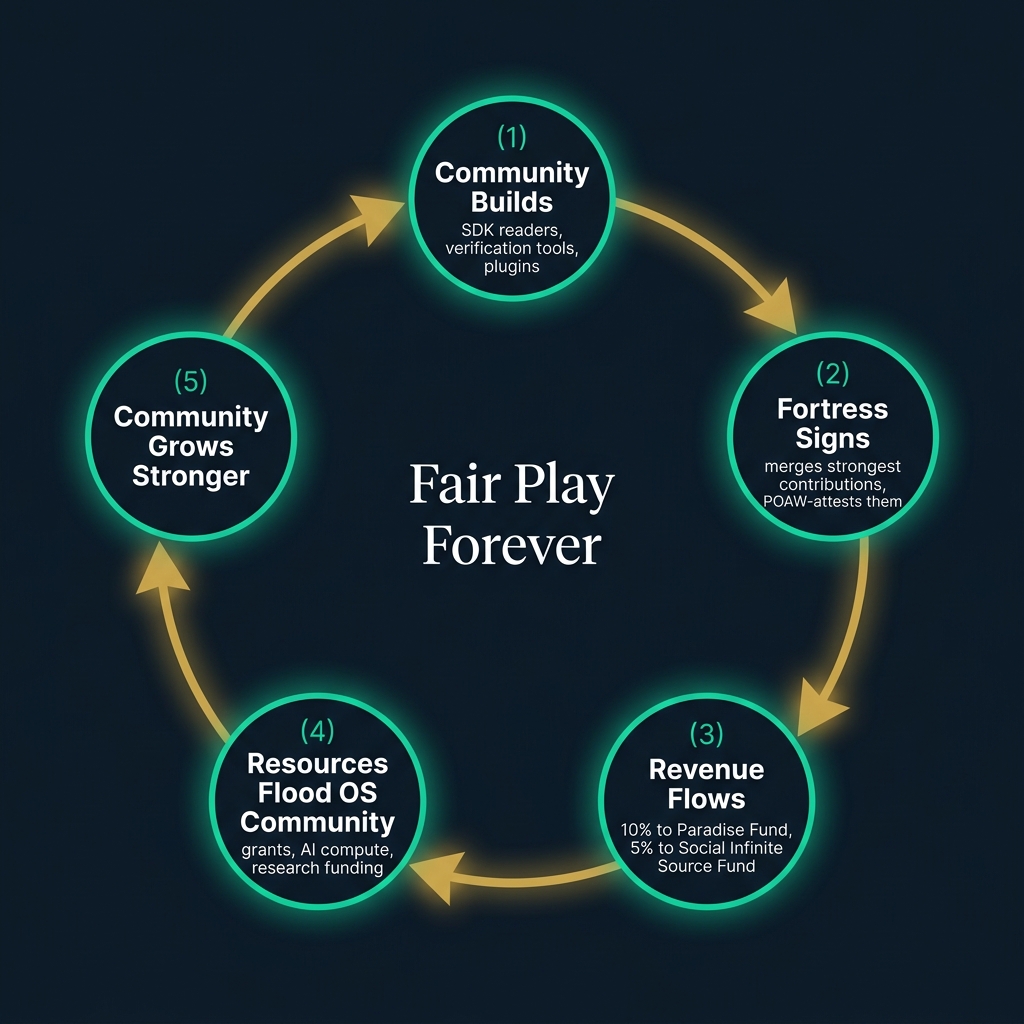
The FAIR Protocol contribution flywheel: how community effort becomes sustainable and self-reinforcing.
Where We Feed Back: The Paradise Fund and Social Infinite Source Fund
This is where most companies would write a blog post claiming "we care about the community" and then do nothing structurally to make that care concrete. We made the decision early: the giving-back mechanism has to be wired into the revenue model, not bolted on as a PR exercise.
Every dollar earned by FORTRESS activates two giving mechanisms. They are not discretionary. They are not dependent on profitability milestones. They are wired to gross revenue — because net revenue is too easy to account away. The design principle: if FORTRESS earns, the planet and the community earn with it.
Planetary well-being: reforestation, ocean cleanup, renewable energy infrastructure in developing economies
Open-source grants, AI compute credits, research stipends, education programs — back to the developers who built the standard
Engineering, infrastructure, legal, and the sustained R&D that keeps the standard advancing
The Social Infinite Source Fund in Practice
The Social Infinite Source Fund is the channel specifically designed to flood resources back into the open-source community. When FORTRESS reaches revenue scale, it activates:
- GPU / NPU compute grants for researchers building on the FAIR Protocol — verified contributions unlock access to our inference infrastructure at zero cost.
- Research stipends for security researchers who publish adversarial findings against the watermarking system. Breaking our standard publicly and responsibly is how we make it stronger.
- Open-source developer grants — quarterly disbursements to contributors whose PRs were merged into official FAIR Protocol repositories. Verified by POAW receipt.
- Education programs — funding for workshops, courses, and certifications that teach digital provenance, post-quantum cryptography, and AI training data ethics — particularly in regions where access to technical education is limited.
The Paradise Fund in Practice
The Paradise Fund operates at a different scale — planetary. The connection between AI data licensing and environmental restoration is not obvious. Here is the chain:
Every AI model trained on unlicensed data is trained inefficiently — toxic data requires more iterations, longer training runs, more energy. A clean data ecosystem means more efficient AI, which means lower carbon cost per inference. FORTRESS doesn't just protect creators. It makes AI more sustainable. The energy saved is the first contribution to the planet. The 10% is the second.
We intend to direct Paradise Fund resources toward verifiable, measurable planetary interventions: projects that can produce satellite-verified outcomes, not marketing claims. The same cryptographic attestation model that protects content will be used to verify environmental impact.
Why We Need Every Developer, Not Just Ours
Standards die in private. TLS works because OpenSSL, GnuTLS, Boringssl, and dozens of other independent implementations all implement the same specification — and they all break each other in ways that make the final standard more resilient, not less.
The FAIR Protocol needs the same adversarial pluralism. If only DESTILL.ai implements the reader, we are a product vendor. If 40 organizations implement independent readers, we become infrastructure. The difference in valuation is not incremental — it is categorical.
This is also why the Apache 2.0 license includes a patent retaliation clause. Any organization that adopts FAIR Protocol and then sues a community contributor for patent infringement automatically loses their FAIR Protocol license. The commons defends itself.
How to Contribute Right Now
The SDK is live at v0.1.0. Here is where to start:
- Node.js:
npm install @fortress/fair-reader - Python:
pip install fortress-fair-reader - Specifications: github.com/fortress-protocol/fair
- DID Method Spec: fortress-protocol.io/did-method/
- Contributor Registry: POAW-attested — all accepted contributions receive an immutable, timestamped receipt
The Deeper Pattern: Architecture as Ethics
The cleanest ethical systems are the ones that don't require anyone to be virtuous. They are designed so that the right behavior is also the profitable behavior. SSL became ubiquitous not because Netscape was generous — but because the alternative (an insecure internet) was commercially untenable.
FAIR Protocol is designed with the same logic. We are not asking AI companies to be ethical. We are building a system where the ethical choice (license the data, support the standard, fund the community) is cheaper, faster, and less legally risky than the alternative. The Paradise Fund and Social Infinite Source Fund are downstream consequences of that design.
When FORTRESS succeeds commercially, the community that verified the standard and the planet that hosted the humans who built it both receive a structurally mandated share. Not a donation. A dividend on the infrastructure they built.
Open Questions — Join the Conversation
- Should the contributor grant amounts be voted on by contributors using a DAO-like mechanism, or set by DESTILL.ai unilaterally? We don't have a final answer.
- Which planetary interventions should the Paradise Fund prioritize first — biodiversity, ocean, air quality, or energy access? We want community input before the first disbursement.
- Should the Social Infinite Source Fund extend to non-developers — journalists, educators, activists — who help spread the standard without writing code?

Hagen Schmidt — Founder, DESTILL.ai
Building the immune system of the digital economy. FORTRESS protects creators and honest AI simultaneously. The Paradise Fund is not a side project — it is the point.
FAIR Protocol Reader: Apache 2.0. FORTRESS Engine: Proprietary. Patent filing #63/994,444 (USPTO). DWT, FAIR, CDPS, and FORTRESS are trademarks of DESTILL.ai. POAW attestation available for all contributor credits on request.