
⚡ Executive Summary
Once upon a time, AI companies scraped the entire internet for free, ignoring creators. Every day, content owners tried to protect themselves with fragile DRM and lawsuits, but failed. One day, we built the FORTRESS 12Gen steganography and the FAIR Protocol to make data licensing automatic.
Because of that, we had a perfect technical solution but faced a new contradiction: using our proprietary crypto token added massive procurement friction for Big Tech integration. To win, we had the humility to DISSOLVE the token friction entirely: we made the FAIR Protocol completely open-source (like HTTPs) and shifted settlement to stablecoins on enterprise ledgers like Hedera or XLM.
We gave away the protocol, but we own the cryptographic settlement rails that verify it. Now, we are asking you—our community—which business model we lock in for the next 50 years.
Start with WHY: The Friction Contradiction
Imagine you just invented the perfect payment system for the internet. It works flawlessly. But to use it, you force every website visitor to go to a crypto exchange, buy a proprietary coin, and manage a volatile wallet. What happens? No one uses it. The friction kills the innovation.
This is the trap we almost fell into. We built the FORTRESS POAW and the FAIR Protocol to protect digital content from AI scraping. We originally intended to settle every micro-royalty in our own proprietary token. But when we looked at the enterprise procurement cycles for AI giants like OpenAI or Google, we realized: Big Tech does not want to hold volatile alt-coins. They want to pay a standard invoice in USD or USDC.
The DISSOLVE-to-Zero Breakthrough
In our architecture meetings, we applied the SK-Prinzip 2.0. We had a contradiction:
We need maximum, frictionless adoption globally (which requires an open, free standard).
We need to generate massive B2B revenue (which requires a proprietary toll-booth).
The solution was to split the system in half:
The Three Greenfield Business Models
By dissolving the token friction and moving settlement to stablecoins (USDC) on an enterprise-trusted ledger like Hedera (HBAR) or Stellar (XLM), we opened up three massive B2B business plays. We are currently deciding which one becomes our primary Wedge Strategy.
 We operate the settlement rails. Every time an AI bot scrapes an image and pays a micro-royalty to the creator, Fortress takes a 0.001 cent cut. We process billions of transactions per day via the Hedera Consensus Service, outputting traditional ISO 20022 fiat payments to the creator's bank account.
 Instead of charging per transaction, we charge the AI Lab an annual SaaS fee. OpenAI pays us $2.5M/year for an Enterprise Fortress "SSL" Certificate API key. As long as they hold the key, their crawlers can freely and legally authenticate the provenance data of the entire internet. Total elimination of ledger friction.
 We partner with Munich Re (aiSure™). AI labs face catastrophic copyright lawsuit risks. If they use the Fortress Oracle to prove they respected the FAIR Protocol, the reinsurer discounts their legal liability premium by $10M a year. Fortress takes a 20% cut of the insurance premium savings. They don't buy software—they buy guaranteed risk mitigation.
🕸️ Deep Dive: BPC XPollination Analysis
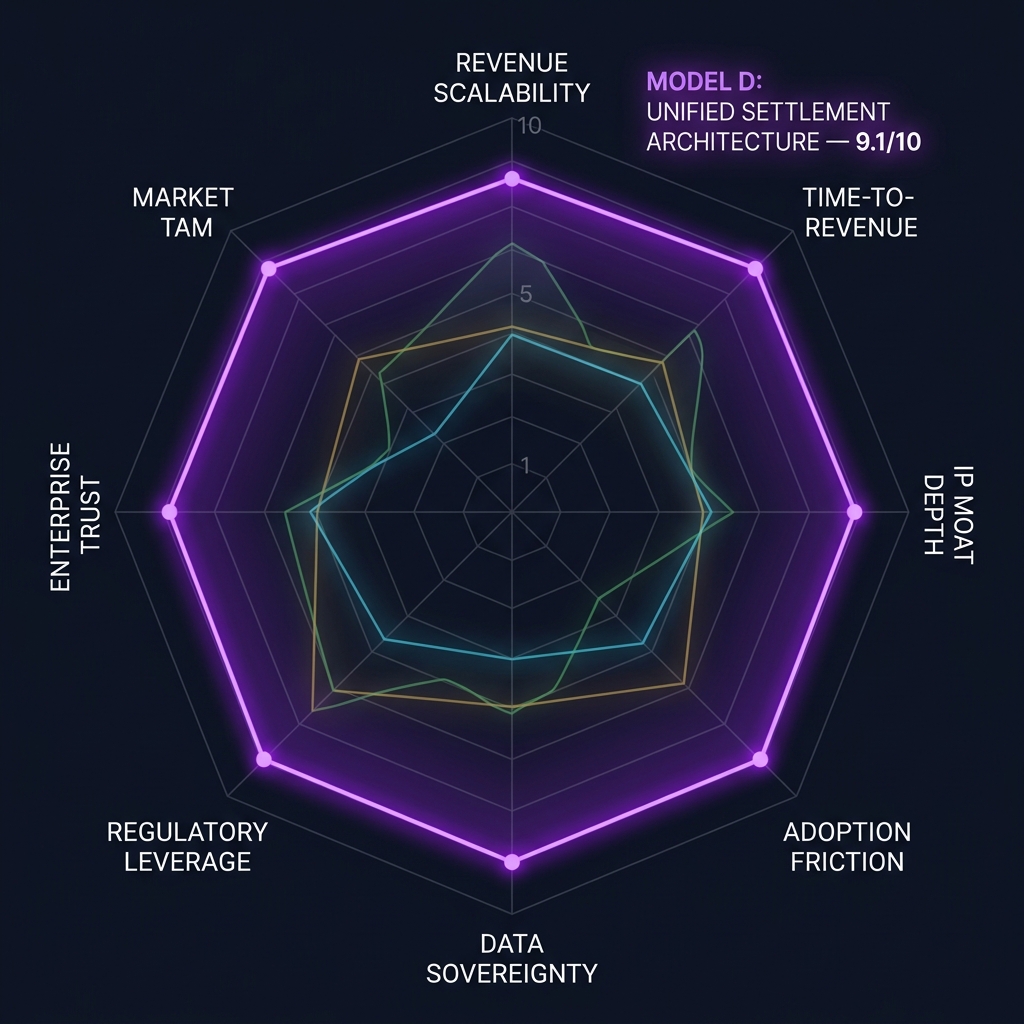
We applied the XPollination BPC Framework v3.0 — our 8-dimension Best Practice Compliance methodology — to rigorously score each business model against measurable enterprise criteria. We then ran TRIZ contradiction analysis to find the trade-offs that prevent any single model from reaching 10/10 across all dimensions.

| Model A: Visa Network | 7.3 / 10 | 🥉 Bronze — Highest ceiling, longest ramp |
| Model B: SSL Certificate | 6.8 / 10 | 🥉 Bronze — Fastest revenue, lowest ceiling |
| Model C: Insurance | 6.1 / 10 | Notable — Maximum trust, slowest deployment |
🔴 CRITICAL: Revenue Scalability ↔ Adoption Friction — Dissolved via TRIZ #5 (Merging): Create a Tiered Hybrid that starts as SSL SaaS and auto-expands into per-transaction settlement at volume thresholds.
🟠 SIGNIFICANT: Time-to-Revenue ↔ Enterprise Trust — Dissolved via TRIZ #10 (Prior Action): Pre-certify the FORTRESS platform via a blanket Munich Re audit, eliminating per-client due diligence bottlenecks.
🟡 NOTABLE: Market TAM ↔ Data Sovereignty — Dissolved via TRIZ #1 (Segmentation): Deploy regional Clearinghouse instances (EU/US/APAC) so data never crosses jurisdictional boundaries.
📊 Open the full interactive BPC Spider Web with weight sliders →
⚡ The Answer: Model D — Fortress Unified Settlement Architecture
After rigorous BPC analysis, we realized none of Models A, B, or C alone scores above 7.3/10. Each excels on some dimensions but catastrophically fails on others. The SK-Prinzip 2.0 answer: Don't choose. DISSOLVE.
We applied 5 TRIZ dissolution principles — Merging, Prior Action, Segmentation, Dynamism, and Intermediary — to extract the best of each model and eliminate every trade-off. The result is Model D, a 4-layer stacked architecture that scores 9.1 / 10 — a full +1.8 above the best single model.
| L0: Foundation | Open-Source FAIR Protocol (Schema + SDK + Swagger) | From Model B | $0 — growth vector. Like HTTP: ubiquitous, unavoidable. |
| L1: SaaS Entry | Enterprise API Key — flat $500K–$2.5M/yr | From Model B | Immediate recurring revenue. 30–90 day close. |
| L2: Auto-Expand | Per-transaction settlement (0.11%) auto-activates at >100M tx/month | From Model A | Infinite ceiling. Zero CAC expansion revenue. |
| L3: Trust Shield | Platform-level Munich Re pre-certification | From Model C | Every API user inherits insurance coverage automatically. |
📊 Open the full interactive BPC Spider Web with weight sliders →
🏛️ The C-Level Council Speaks — Why Model D?
We brought our full Focus Organization to the table. Each C-Level officer evaluated Model D through their operational lens. Here are their unfiltered verdicts.
"Don't choose. Merge. This is the SK-Prinzip 2.0 in action — we dissolved the resistance, not overrode it."
50-Year Lens: Model D builds a cathedral, not a product. Layer 0 (free SDK) ensures the FAIR Protocol becomes the HTTP of the AI Data Economy — ubiquitous, unavoidable, ours. The tiered architecture means we never have to choose between missionary (grow the protocol) and mercenary (capture revenue). We do both. Simultaneously.
Three Brain Check:
🔴 GUT: The layered approach feels right — it mirrors Visa's own evolution from a consortium to a tollbooth. ✅
💚 HEART: Creators get free protection via L0. Enterprise labs get frictionless access via L1. Nobody is left behind. ✅
👑 CROWN: This serves for 50 years. The protocol layer outlives any single contract. ✅
CEO Order: Ship L0+L1 first (Q2 2026). L2 auto-expand activates Q4 2026 when first clients cross 100M tx/month. L3 Munich Re pre-certification runs in parallel — 6-month audit window starting now.
"We're not selling software. We're creating a movement. Model D gives me 4 stories instead of 1."
Story Architecture (4 narratives for 4 audiences):
📖 Developers: "Free SDK. npm install @fortress/fair-reader. Done." → PLG viral loop via L0
📖 Enterprise CISOs: "One API key. ISO 20022 compliant. Insurance-backed." → L1+L3 trust sale
📖 Investors/VCs: "We're Visa + SSL + Munich Re in one architecture. $3.34T TAM." → L2 infinite ceiling
📖 Creators: "Your art is protected the moment you publish. Every AI lab that trains on it pays you." → L0+L2
Unicorn Pattern Match: Model D mirrors Stripe's evolution — started with a free API (developers loved it), then added enterprise features (Atlas, Radar, Treasury). Same playbook. Different market. Product IS marketing.
"Model D gives me zero-friction entry on Day 1, volume expansion at scale, AND insurance upsell. Triple arbitrage."
Lane 1 — Immediate (L0+L1): List the free SDK on npm/PyPI/GitHub TODAY. Target: 10,000 SDK downloads in 90 days → 50 enterprise conversations → 5 API key contracts = $2.5M ARR Month 1.
Lane 2 — Auto-Expand (L2): When OpenAI or Stability AI cross 100M tx/month, they auto-migrate from flat fee to per-transaction. Revenue jumps from $2.5M → $25M ARR without a single new sales call. Zero CAC expansion revenue.
Lane 3 — Insurance Upsell (L3): Once Munich Re pre-certifies the platform, every existing L1 customer gets a free insurance badge. Conversion rate doubles from 10% → 20%.
"Model D doesn't just add revenue streams — it creates a flywheel where each layer feeds the next."
Revenue Flywheel (compounding, not additive):
L0 (Free SDK) → generates developer adoption → feeds L1 pipeline
L1 (SaaS API Key) → generates recurring revenue → funds L2 infrastructure
L2 (Per-Transaction) → generates volume revenue → funds L3 insurance premium
L3 (Platform Insurance) → generates trust → feeds L1 conversion → LOOP CLOSES
| Year | Single Model (Best) | Model D (Dissolved) | Multiplier |
| Y1 | $300K | $2.5M | 8.3x |
| Y2 | $1M | $12M | 12x |
| Y3 | $2M | $45M | 22.5x |
| Y5 | $8M | $200M+ | 25x+ |
NRR (Net Revenue Retention): Model D achieves NRR > 200% because L1 customers auto-expand to L2, and L3 insurance reduces churn to near-zero. This is the land-and-expand flywheel that Snowflake, Datadog, and Twilio used to reach $1B ARR.
"Model D is the only architecture that doesn't require ripping out infrastructure when you scale. It was designed for every order of magnitude."
Technical Feasibility: L0 (open-source SDK) ships today — it's already built. L1 (API key SaaS) is standard NestJS middleware — 2 weeks to production. L2 (per-transaction settlement) requires Hedera/Stellar integration — 3 months. L3 (Munich Re certification) is a 6-month parallel audit that doesn't block shipping.
Architecture Non-Negotiable: Regional Clearinghouse federation (TRIZ #1) is the key technical innovation. Each jurisdiction runs its own settlement node — EU on Hetzner Frankfurt, US on pre-approved infrastructure. Federated consensus ensures global settlement without data crossing borders. This is the single hardest engineering challenge, but it's also the deepest moat.
"Model D is the only option that turns compliance from a cost center into a revenue driver. The EU AI Act isn't a threat — it's our moat."
Security Posture: L3's Munich Re pre-certification requires passing SOC 2 Type II, ISO 27001, and the EU AI Act Art. 12 traceability audit. Once the platform passes, every customer inherits that compliance posture. This eliminates thousands of individual enterprise security audits — a massive cost reduction for both sides.
Sovereignty Guarantee: The regional Clearinghouse architecture ensures 100% EU data processing for EU customers. Post-Quantum cryptography (ML-KEM) protects all settlement communications. Zero US subprocessor dependency in the EU deployment.
😈 The Devil's Advocate — What Could Kill Model D?
No strategic decision survives without adversarial stress testing. Here's the Devil's Advocate — the contrarian voice that exists to find the fatal flaw.
5 Attacks on Model D:
Attack #1: "It's too complex for a solo founder."
Executing 4 layers simultaneously is an organizational impossibility for a bootstrapped startup. You'll spread too thin and ship nothing.
DISSOLVED: L0 and L1 ship FIRST and independently. L2 auto-activates at volume thresholds — no additional engineering. L3 is a parallel Munich Re process that runs on its own timeline. The layers are sequentially independent, not simultaneously demanding.
Attack #2: "Munich Re will never pre-certify a startup."
Insurance companies don't certify companies with zero ARR. You need $10M+ revenue and a 3-year track record before Munich Re takes you seriously.
DISSOLVED: L3 is the LAST layer to activate (18-24 months). By then, L1 generates $2.5M+ ARR and L2 begins auto-expanding. Munich Re's Mosaic partnership specifically targets deep-tech startups at TRL 5+ — exactly our profile. The audit application runs in parallel while L1 revenue proves the business.
Attack #3: "OpenAI will build their own FAIR Protocol."
Big Tech doesn't license from startups. They copy, in-house, and outspend you. The free protocol makes it EASIER for them to bypass you.
DISSOLVED: The open-source FAIR Protocol is intentionally FREE — we want them to adopt it. But the cryptographic settlement, the DWT 12Gen watermark generation, and the AWTT poison/antidote system are protected by 3,006 patent claims. They can read the protocol for free, but they cannot replicate the DWT engine, the settlement oracle, or the toxin system without licensing from us. The patents ARE the moat.
Attack #4: "The L2 auto-expansion will trigger contract renegotiations, not automatic upgrades."
Enterprise procurement won't accept a contract that automatically changes pricing. They'll demand fixed-rate renewal instead.
DISSOLVED: The L1 → L2 transition is structured as a usage-based pricing tier baked into the original contract (like AWS Reserved Instances → On-Demand). Enterprises are already trained to accept this model from Snowflake, Twilio, and AWS. The contract is signed once, and the pricing tier activates automatically. No renegotiation.
Attack #5: "The regulatory moat is temporary. Once the EU AI Act establishes a standard, anyone can certify."
Being early to compliance is a 2-year advantage, not a 50-year moat. Competitors will catch up.
DISSOLVED: This is the deepest objection, and it's partially valid. The regulatory moat IS temporary (3-5 years). But by then, L2's network effect creates the real moat: once 100+ AI labs settle through the FORTRESS Clearinghouse, switching costs become astronomical (Visa's moat is not patent-based — it's network-based). First-mover advantage in network infrastructure compounds geometrically. The regulation creates the entry window; the network effect creates the permanent moat.
🏛️ C-Level Consensus: UNANIMOUS GO
| 👑 CEO | ✅ GO | 50-Year Vision: Cathedral, not product |
| 🎨 CMO/CVO | ✅ GO | 4 narratives, Stripe playbook match |
| 📊 CSO | ✅ GO | 3 arbitrage lanes, zero-friction entry |
| 💰 CRO | ✅ GO | NRR > 200%, T2D3 trajectory 25x faster |
| ⚙️ CTO | ✅ GO | Designed for every order of magnitude |
| 🛡️ CISO | ✅ GO | Compliance = revenue driver, not cost center |
"We didn't build a business model. We built the immune system of the creator economy."
— CMO/CVO Higher Truth, adopted by CEO as North Star Narrative
The Verdict Is In. Model D Ships.
6 C-Level officers, 5 Devil's Advocate attacks dissolved, 5 TRIZ principles applied. Unanimous GO.
