The Fortress Patent Moat: Why 422 Claims Across 3 Waves Give Creators Unprecedented Strategic Leverage
By Hagen Schmidt | Founder, DESTILL.ai | April 10, 2026
⚡ Executive Summary
The AI scraping economy has treated creator data as an infinite, free resource. Traditional legal defenses are too slow, and infrastructure bans are too fragile. The DESTILL.ai FORTRESS system shifts the paradigm with 422 active patent claims, extracted from our 3,297-claim provisional portfolio, strictly protecting technical mechanisms for data sovereignty, cryptographic enforcement, and automated legal settlements. Instead of filing one massive, vulnerable patent, we deploy 8 wave-filed non-provisionals across 3 coordinated waves plus CIP continuations to maximize USPTO evaluation efficiency while maintaining an airtight enforcement perimeter around our 3-Shard architecture. NP-1 (Steganographic Content Protection) — our first non-provisional — has completed prior art clearance and formal claim drafting as of April 2026.
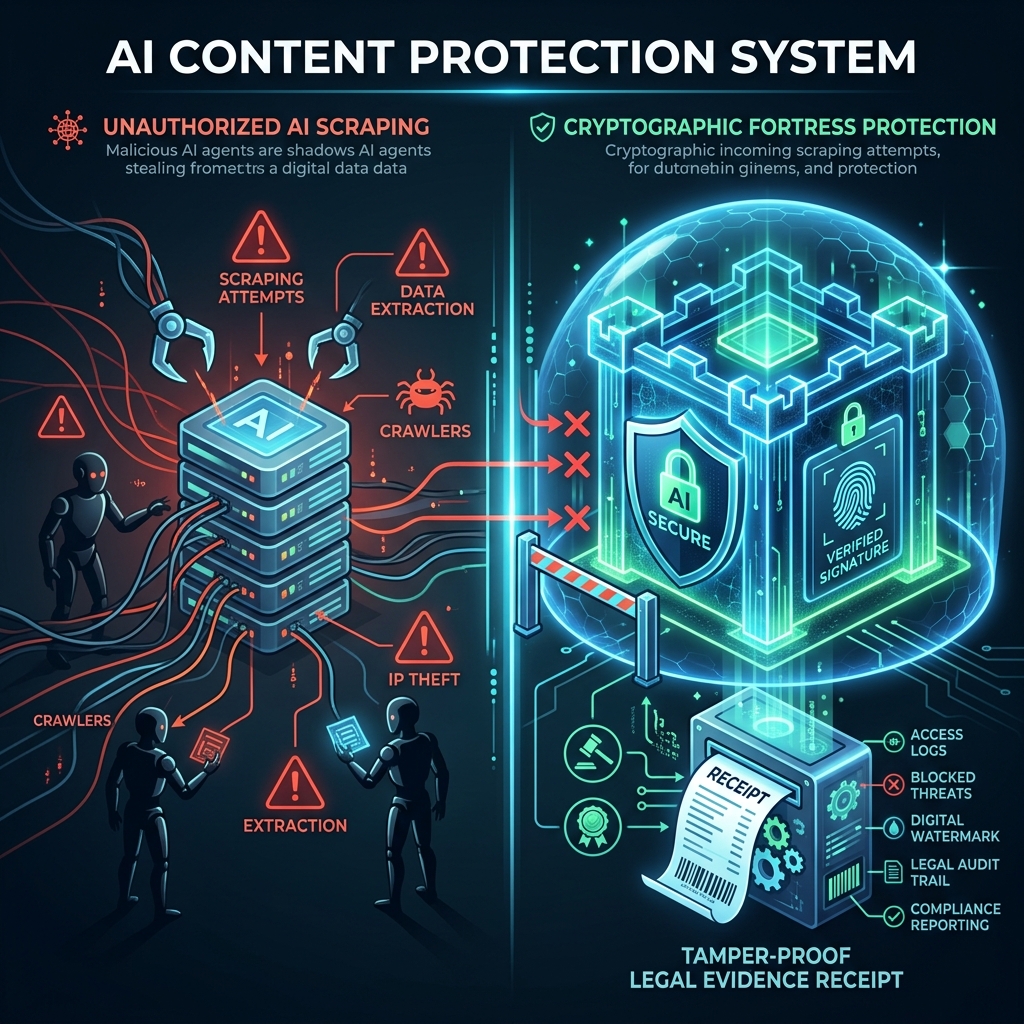
Start with WHY: The "Free Data" Illusion
If you are an agency managing creators, an independent journalist, or a software engineer sharing code, you face a massive structural disadvantage. Today's GPAI models scrape your content, index it, and instantly dilute your market value. When you attempt to fight back, you realize the asymmetry: you have a simple terms-of-service agreement, and they have billion-dollar data-ingestion pipelines designed specifically to ignore robots.txt.
We realized that trying to win a legal battle using 20th-century copyright doctrine against autonomous web scrapers is a losing game. The only way to win is to technically enforce the legal contract at the very edge of the network, transforming a simple "Do not scrape" request into an irrefutable cryptographic receipt.
It is in the leverage it provides to permanently alter the unit economics of your opponent." — Hagen Schmidt
The Technical Architecture of Accountability
At DESTILL.ai, we index and protect over 3,297+ provisional patent claims filed under parent application 63/994,444. Of those, the FORTRESS SDK relies on 422 active claims, heavily concentrated in three key technical pillars. Our prior art research has confirmed clearance against Digimarc (800+ watermark patents), Custos Media Technologies (blockchain bounty patents), and Microsoft Research's Argus system — with 6 novel anchors that no competitor has patented. Here is how we orchestrated our Intellectual Property (IP) strategy to provide absolute leverage for our partners and investors.
The IP Advantage: If an AI model scrapes this content, the canary token becomes mathematically embedded in its latent space. Our patents cover the precise method of encoding using post-quantum ML-DSA signatures, multi-resolution adaptation (720p/1080p/4K), and BER-based confidence scoring. We don't just know they stole it — we prove it cryptographically with quantum-resistant non-repudiation. NP-1 (20 claims) filed with prior art clearance complete.
The IP Advantage: Scrapers are evolving to bypass simple IP bans. Our IP protects the PSEE (Proactive Scraping Evidence Engine), which identifies not just the IP address, but the unique behavioral signature of the autonomous agent. This forces accountability regardless of proxy rotation.
The IP Advantage: Generating a PDF is easy; generating a legally binding, ZKP-verified evidence chain that a law firm can immediately use for bulk litigation without violating GDPR is an architectural miracle. We patented the exact pipeline. Our False Accusation Burn Protocol (stake-and-slash) ensures no fraudulent claims pollute the evidence chain — a game-theoretic innovation absent from all competing systems.
The 20-Claim Limit & 3-Wave Continuation Strategy
When executing non-provisional filings, many startups make a critical mistake: they stuff 100+ claims into a single "monster patent" to save on filing fees. The USPTO charges $120 per excess independent claim (beyond 3) and $40 per excess total claim (beyond 20) at Micro Entity rates. A single 422-claim filing would cost $29,500+.
But the fee isn't the real problem — the restriction requirement is. An Examiner faced with 100+ disparate claims will force the applicant to heavily restrict the patent, stalling the process and creating vulnerabilities. We solved this with a disciplined wave strategy:
NP-2: Autonomous Scraping Detection (20 claims, 3 ind.) — ⏳ In pipeline
NP-3: Forensic Evidence & Settlement (20 claims, 3 ind.) — ⏳ In pipeline
NP-5: Swarm/Fleet Detection (20 claims)
NP-6: ZKP Verification & Canary Rotation (20 claims)
Filed as Continuation Applications under 35 U.S.C. § 120 — same 2026-03-02 priority date.
NP-8: Remaining claims (10–19 claims)
Completes coverage of all 422 FORTRESS claims for a total of $3,136 — 85% cheaper than a single monster patent.
What This Means for Investors and Creators
For investors, IP is only as valuable as its enforceability. The Fortress SDK isn't an obscure theoretical algorithm; it is an enforcement mechanism mapped directly to the EU AI Act's Article 53 obligations. If a GPAI provider fails to respect web boundaries, our 3-Shard architecture provides the technical proof to extract out-of-court settlements.
Our prior art research confirmed 6 novel anchors that differentiate FORTRESS from every competitor:
- 🔐 Post-Quantum ML-DSA signatures — no competitor uses lattice-based crypto for watermarks
- 🌐 Client-side WASM + ZKP extraction — suspect media never leaves the device
- 🔥 False Accusation Burn — game-theoretic stake-and-slash prevents fraud
- 📡 Per-frame session keys — real-time streaming watermarks, not static file embedding
- 📊 BER confidence scoring — communication-theoretic forensic metrics
- ⚖️ Automated settlement pipeline — forensic evidence to legal documents in one step
For creators and agencies, the Fortress SDK transforms standard content hosting into a high-margin data governance portal. You aren't just selling content anymore; you are managing a sovereign asset vault equipped with an automated revenue-recovery engine.
Every claim logged in our patent_claim_registry.json — all 3,297+ across the full NI ecosystem, with 422 FORTRESS-specific claims ready for prosecution — serves one singular goal: shifting the balance of power back to the human creator.